
Why is my investment return different from the fund’s return?
Article written by Jason Choy, InvestNow Senior Portfolio Manager – October 2026

If you’ve ever compared your investment return with the return reported by a fund, you may have noticed they don’t always match.
Sometimes your return will be lower. Sometimes it might be higher.
Your first thought may be something’s gone wrong. Maybe the difference is due to fees, or maybe you’re reading the numbers incorrectly.
But there is another explanation: the return earned by a fund and the return earned by an investor in that fund are two different concepts altogether.
Understanding why can help investors better interpret their own results, avoid some of the most common investing mistakes, and focus on the behaviours that matter most over the long term.
The fund return is not necessarily your return
When a fund reports its performance, it’s typically reporting what’s known as a “time-weighted return”.
This is a useful metric because it shows how the fund performed as a result of the underlying assets it’s chosen to invest into and the changes in their market values. This can help investors assess the outcomes of the fund manager’s investment decisions, and enables a more ‘apples-to-apples’ comparison of how one fund performed against another.
The calculation of the time-weighted return assumes the investor put a lump sum into the fund at the beginning of the measurement period and left it there untouched for the entire journey (i.e. no additional investments or withdrawals were made during the period).
But most investors don’t behave that way in real life.
They contribute to their KiwiSaver every payday. They make regular payments into their portfolio. They move money from one fund to another. Or they’re simply withdrawing money for liquidity needs.
In all of these scenarios, the amount you have invested in the fund changes over time.
Real-life investing often involves multiple cash flows occurring throughout the measurement period. The size and timing of those cash flows, and how the underlying investments performed between cash flows, will impact the actual return that you achieve as an investor in a fund.
This is why your personal, investor-level return can be different from the fund’s reported return.
Morningstar calls this difference the ‘investor return gap’. Its Mind the Gap research found that, over the 10 years to the end of 2025, the average dollar invested in US mutual funds and ETFs earned 8.7% a year, compared with 9.9% for the funds themselves – a gap of 1.2% a year.
A gap in practice
Imagine a fund starts the year at with a unit price of $1. It falls -20% in the first six months before recovering and finishing the year +10% higher than where it started.
An investor who had the full amount invested throughout the year would have captured the fund’s full +10%. Another who invested the full amount at the six-month low would be up +37.5%. A third investor who pulled all their money out after the first six months would have locked in a -20% loss.
Investors are more likely to adjust part of an investment than exit completely, but the principle applies: the size and timing of those cash flow decisions affects their personal investor return.
In all of these scenarios, the fund’s reported return is the same. The investor’s return is what’s different.
Not all gaps are bad
It can be tempting to think any gap between investor returns and fund returns is a problem to be minimised.
In reality, some gaps are simply the natural by-product of healthy investing behaviour.
Take KiwiSaver for example – your employee, employer and government contributions arrive throughout the year. Every contribution is buying units at different prices – sometimes higher, sometimes lower.
The return on your actual balance therefore reflects not only the performance of your KiwiSaver fund, but also the timing of your contributions, and will almost never exactly match the fund’s published return.
The same concept applies to other sensible investment activities like setting up a regular investment plan, rebalancing a portfolio, funding a first-home withdrawal, or gradually reducing risk as retirement approaches.
While these decisions may reduce or increase your investor return relative to the fund over a particular period, they can still be entirely appropriate given your goals and circumstances.
After all, investing isn’t about achieving exactly the same return as a fund factsheet. It’s about using investments to help achieve your financial objectives.
When the gap becomes a problem
Investors can also create a gap for less productive reasons, most commonly when attempting to ‘time’ the market.
It sounds great in theory. If a fund isn’t performing well, pull your money out and avoid the losses. Even better, shift your money into a fund that’s performing well and take advantage.
But while a lucky few might have some success, research consistently shows that investor attempts to time markets often detract from returns rather than enhance them.
The challenge is that successful market timing requires investors to make two decisions correctly: when to get out and when to get back in.
Getting one decision right is difficult enough. Getting both right consistently is extraordinarily hard.
Even elite professional fund managers supported by research teams and sophisticated analytical tools only get around half of their market calls right. For everyday investors, successfully predicting both market falls and market recoveries can be even harder.
It’s the old adage, time in the market beats timing the market. Over shorter periods, markets can be highly unpredictable, and avoiding the worst days can also mean missing some of the strongest recoveries.
Recent AFR analysis modelled a hypothetical investor who put money into the market immediately before three of the biggest crashes since 2000.
They called him ‘Unlucky Steve’, and found that even with the worst timing imaginable, if he stayed invested and resisted the inevitable urge to divest, he would emerge at the end of 2025 with a return of 7.6% per year – more than double the return he would have had just keeping his money in the bank.
A big part of the reason is, if you’re absent for the fall, you’re absent for the recovery. By the time confidence returns and an investor feels comfortable getting back in, markets may already have recovered significantly.
This doesn’t mean investors should never change their investments. There are plenty of legitimate reasons to do so.
But the point is to distinguish between a strategic decision based on your long-term financial goals and circumstances, and a knee-jerk reaction to recent performance.
Why some investments have larger gaps than others
One of the more interesting findings from Morningstar’s research is that the size of the investor return gap varies significantly across different types of investments.
Diversified broad market investments such as US share market funds, which many investors use as long-term core holdings, showed some of the smallest gaps, with investors capturing almost all of the funds’ returns.
By contrast, larger investor gaps tended to occur in more specialised investments, such as thematic sector funds, alternatives, and crypto-related investments.
These investments are often more volatile and are more likely to attract investors after periods of strong performance, only for enthusiasm to fade when markets become more challenging.
Morningstar found this pattern was particularly evident in crypto ETFs, where the investor return gap was a whopping 14 percentage points less than the fund’s return. This highlights just how significant the impact of investor cash flows can have in highly volatile environment, particularly for those that engage in misfortunate attempts to ‘time’ the markets.
Put simply, investors often do much better at capturing returns when they treat investments as long-term building blocks rather than short-term opportunities to chase trends.
How can you minimise the gap?
While most will never be able to fully close the gap – there are still some relatively simple ways to improve your chances of capturing more of the returns your investments generate.
- Stay informed, but don’t react to the noise. This is one of InvestNow’s core Investing Principles. Markets will rise and fall. Understanding why your investments behave as they do is useful, but reacting to every movement isn’t.
- Stay invested. Trying to jump in and out of markets introduces another decision: When to get back in? Getting both decisions right is incredibly difficult.
- Invest consistently. Making regular contributions reduces the temptation to wait for the “right” time to invest. This is already built into the way many people invest through KiwiSaver.
- Avoid unnecessary switching. Changing funds because another investment is performing better essentially turns a long-term investment strategy into a series of short-term bets. Not to mention, there may be fees attached to every switch, which would stack the odds against you even more.
See your own performance story
Historically, it has been easy to see how a fund has performed, but much harder to understand how your own money within that fund has performed after accounting for contributions and withdrawals.
InvestNow’s new ‘Performance By Asset’ feature, available under the ‘Performance’ tab when you log into your account, is designed to help bridge that gap.
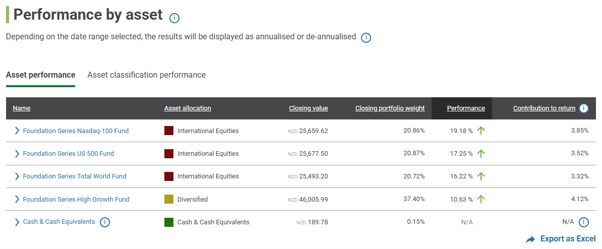
The amounts and performance figures shown are for illustrative purposes only.
It shows your personal investor-level return for each fund or asset class you’re invested in over your chosen period, taking into account your own cash flows. If you’re invested in multiple funds or asset classes, the ‘Contribution to return’ measure also helps show how each investment has contributed to your overall portfolio return.
In the coming months, we also expect to add fund-level returns alongside this investor-level reporting. Having the two measures together will make it easier to compare how the fund performed with how you experienced that performance, and better understand what sits behind any difference.
The aim isn’t necessarily to achieve exactly the same return as the fund. As we’ve seen, there are plenty of good reasons why the two might differ. Rather, it gives you another lens for understanding your investment journey and the impact your own investment decisions have had along the way.
Focus on the return that matters
A fund’s published return tells you how the investment performed. Your personal return tells you how you experienced that performance.
There will often be a gap between the two, and that isn’t necessarily a bad thing. Regular contributions, withdrawals, rebalancing or adjusting your portfolio as your circumstances change can all create differences for perfectly sensible reasons.
What matters is understanding why the gap exists, and whether the decisions behind it are helping you progress towards your long-term goals or getting in the way.
That means distinguishing sensible changes driven by your circumstances from behaviours that can detract from returns, such as chasing recent winners, reacting to short-term market moves or repeatedly trying to pick the right time to get in and out.
Choosing appropriate investments is an important part of that equation. But so is what you do once you own them. Staying invested, investing consistently and making changes for the right reasons can be just as important as the investments themselves.
That is ultimately what can help turn investment returns into investor returns.
Disclaimer:
This information is provided by InvestNow Saving and Investment Service Limited (“InvestNow”). The information and any opinions in this publication are based on sources that InvestNow believes are reliable and accurate. InvestNow, its directors, officers and employees make no representations or warranties of any kind as to the accuracy or completeness of the information contained in this publication and disclaim liability for any loss, damage, cost or expense that may arise from any reliance on the information or any opinions, conclusions or recommendations contained in it, whether that loss or damage is caused by any fault or negligence on the part of InvestNow, or otherwise, except for any statutory liability which cannot be excluded. All opinions and market commentary reflect InvestNow’s judgment on the date of this publication and are subject to change without notice. This disclaimer extends to any entity that may distribute this publication. The information in this publication is not intended to be financial advice for the purposes of the Financial Markets Conduct Act 2013, as amended by the Financial Services Legislation Amendment Act 2019. In particular, in preparing this document, InvestNow did not take into account the investment objectives, financial situation and particular needs of any particular person. Professional investment advice from an appropriately qualified adviser is recommended before making any investment. All Investments involve risk. Examples of specific fund performance are for illustrative purposes only and are not intended as a recommendation. Any projections, scenarios, or modelling presented are illustrative only and are not forecasts or predictions of future performance. Past performance is not a reliable indicator of future results.
The issuer and manager of the InvestNow KiwiSaver Scheme and Foundation Series Funds is FundRock NZ Limited. For the InvestNow KiwiSaver Scheme Product Disclosure Statements click here. For the Foundation Series Product Disclosure Statements click here. The Foundation Series Core Funds are subject to buy/sell transaction fees of 0.50% on all investments (buy transaction fee) and 0.50% on all redemptions (sell transaction fee).



Leave A Comment