
The only free lunch in investing: A practical guide to diversification
Article written by Louis Nel, Head of External Managers & Partnerships, Harbour Asset Management

Higher returns normally come with higher risk, greater uncertainty or less liquidity. Diversification is different. Often described as the “only free lunch in investing”, diversification allows investors to reduce the amount of risk they are exposed to without necessarily giving up return. In doing so, investors should experience better risk-adjusted returns. Diversification is one of the simplest ideas in investing, but also one of the most powerful.
What is diversification?
At its simplest, diversification means not putting all your investment eggs in one basket. But good diversification goes considerably further than simply owning lots of investments. A genuinely diversified portfolio combines investments that behave differently from one another. That might mean spreading a portfolio across different asset classes such as cash, bonds, shares and property. Within those asset classes, it can also mean investing across different countries, sectors, companies, investment styles, and managers.
The key point is that these investments should be exposed to different drivers of return. For example, owning 50 technology companies may look diversified because there are 50 individual investments. But if they are all affected by the same factors, the portfolio may still be highly concentrated. Diversification, therefore, is not simply about owning more. It is about owning different sources of risk and return. For many investors, managed funds often provide a simple and effective way to achieve diversification, offering access to a broad range of investments within a single portfolio.
Why does diversification matter?
The most obvious benefit is that diversification reduces reliance on any single investment. If one company, sector, country or asset class performs poorly, it represents only part of the portfolio. Other holdings can potentially offset some of that weakness. This has several benefits.
First, diversification can smooth the investment journey. Different investments do not rise and fall at precisely the same time. Combining assets whose returns are imperfectly correlated can therefore reduce the overall volatility of a portfolio. Some would say this also leads to a better night’s sleep for the investor!
Second, diversification can reduce the severity of losses. This matters because recovering from a loss becomes progressively more difficult as that loss gets larger. A portfolio that falls 10% requires an 11% return to recover. A portfolio that falls 50% needs a 100% return, to get back to where it started.
Third, diversification helps portfolios cope with different economic environments. Equities may thrive when economic growth and corporate profits are strong, while government bonds can be valuable when growth disappoints and interest rates fall. Infrastructure, property and other real assets can respond differently again, particularly during inflationary periods. No single asset class is ideally suited to every environment.
Perhaps most importantly, diversification recognises a fundamental truth about investing: we do not know what the future holds. Legendary investor Sir John Templeton summed this up nicely when he famously said, “The only investors who shouldn’t diversify are those who are right 100% of the time.”
Putting theory into practice
The table below ranks the calendar year returns from 2011 to 2025 of seven asset classes, as well as a ‘Balanced Portfolio’. The returns are ranked from highest to lowest. The coloured squares move around from year to year due to macroeconomic factors (such as changes in inflation, interest rates and GDP growth), geo-politics, and investor sentiment, impacting the asset classes in different ways.
The Balanced Portfolio combines the seven asset classes into a 40% income assets[1]/60% growth assets[2] portfolio. Unlike some of the asset classes which have found themselves at the top and bottom of the table, the Balanced Portfolio illustrates the benefit of combining different sources of risk and return. It wasn’t the top performer in any given year, but it also wasn’t ever the worst performer. Instead, it delivered returns that sat consistently near the middle of the rankings. By contrast, five of the seven asset classes have had a turn at the top of the table, and all seven have had a turn at the bottom of the table.
[1] Income assets = NZ Cash, NZ Bonds, Global Government Bonds (hedged), and Global Corporate Bonds (hedged).
[2] Growth assets = NZ Equities, Global Equities (hedged), and Global Equities (unhedged).
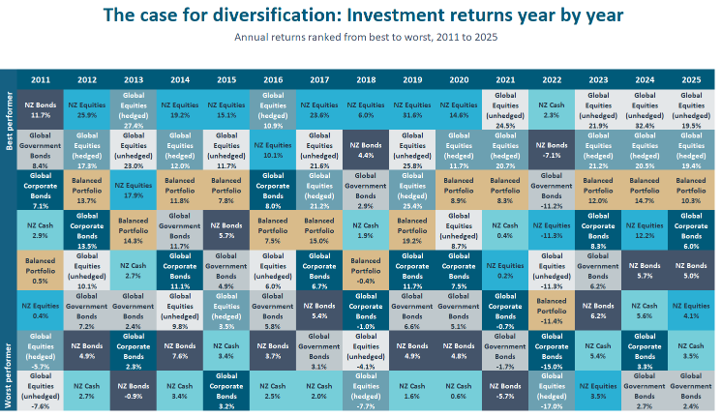
Source: Bloomberg, Harbour Asset Management. Based on calendar year returns.
Indices: NZ Cash – Bloomberg NZBond Bank Bill Index; NZ Bonds – Bloomberg NZBond Composite 0+ Yrs Index; Global Government Bonds – Bloomberg Global Treasury Total Return Index Hedged NZD; Global Corporate Bonds – Bloomberg Global Aggregate Corporate Total Return Index Hedged NZD; NZ Equities – S&P/NZX 50 Gross with Imputation Index; Global Equities (hedged) – FTSE All-World 100% Hedged to NZD Net Tax Index; Global Equities (unhedged) – FTSE All-World Net Tax in NZD Index; Balanced Portfolio – a 40% income/60% growth custom composite of the seven market indices. Past performance is not a reliable indicator of future performance.
A more resilient portfolio
Diversification is about much more than reducing volatility. It can make a portfolio more resilient by giving it multiple ways to generate returns. By creating a smoother investment experience, it can make it easier for investors to remain invested during periods of market stress. This behavioural benefit should not be underestimated because liquidating an investment during a period of market stress creates two problems for the investor. First, they crystalise their losses. And second, it’s unlikely that they’ll be able to pick the bottom of the market, which means that when they eventually re-enter the market, they’ll likely have missed out on some of the gains already made. Diversification will not eliminate losses, nor does it guarantee positive returns. However, it should reduce the magnitude of losses and increase the chance of positive returns over the long term.
Think like a decathlete
Perhaps the best way to think about diversification is to imagine a decathlon. A decathlete must compete across ten very different disciplines, from the 100 metres and long jump to the shot put, pole vault and 1,500 metres. The athlete who wins the decathlon does not necessarily win every event. In fact, they may not be the best athlete in any single discipline. What matters is being consistently good across many different events. A diversified portfolio works in much the same way. The goal is to build a portfolio capable of competing through several different economic and market scenarios.
If you’d like to learn more about the Harbour Asset Management, please refer to the Product Disclosure Statements and other disclosure material available on Harbour landing page on InvestNow.
Disclaimer:
This publication is provided for general information purposes only. The information provided is not intended to be financial advice. The information provided is given in good faith and has been prepared from sources believed to be accurate and complete as at the date of issue, but such information may be subject to change. Past performance is not indicative of future results and no representation is made regarding future performance of the Funds. No person guarantees the performance of any funds managed by Harbour Asset Management Limited.
“BLOOMBERG®” and the Bloomberg indices listed herein (the “Indices”) are service marks of Bloomberg Finance L.P. and its affiliates, including Bloomberg Index Services Limited (“BISL”), the administrator of the Indices (collectively, “Bloomberg”) and have been licensed for use for certain purposes by the distributor hereof (the “Licensee”). Bloomberg is not affiliated with Licensee, and Bloomberg does not approve, endorse, review, or recommend the financial products named herein (the “Products”). Bloomberg does not guarantee the timeliness, accuracy, or completeness of any data or information relating to the Products.
The S&P/NZX 50 Gross with Imputation (“Index(es)”) and associated data are a product of S&P Dow Jones Indices LLC, its affiliates and/or their licensors and has been licensed for use by Harbour Asset Management Limited. © 2025 S&P Dow Jones Indices LLC, its affiliates and/or their licensors. All rights reserved. Redistribution or reproduction in whole or in part are prohibited without written permission of S&P Dow Jones Indices LLC. For more information on any of S&P Dow Jones Indices LLC’s indices please visit www.spdji.com. S&P® is a registered trademark of Standard & Poor’s Financial Services LLC (“SPFS”) and Dow Jones® is a registered trademark of Dow Jones Trademark Holdings LLC (“Dow Jones”). Neither S&P Dow Jones Indices LLC, SPFS, Dow Jones, their affiliates nor their licensors (“S&P DJI”) make any representation or warranty, express or implied, as to the ability of any index to accurately represent the asset class or market sector that it purports to represent and S&P DJI shall have no liability for any errors, omissions, or interruptions of any index or the data included therein.
FTSE. LSEG is the administrator of certain indices and benchmarks as detailed at https://www.lseg.com/en/ftse-russell/benchmark[1]statements. No other information provided, displayed or contained in any LSEG service is made available for use as a benchmark, whether in relation to a financial instrument, financial contract or to measure the performance of an investment fund, or otherwise in a way that would require the relevant information to be administered by a benchmark administrator pursuant to the Benchmarks Regulation (the “Prohibited Use”). LSEG does not grant rights for you to access or use such information for the Prohibited Use and you may breach the Benchmarks Regulation and/or any contract with LSEG if you do. In the event that you identify the Prohibited Use of information by any person, you must promptly notify LSEG and provide such details as we may reasonably request to ensure the cessation of the Prohibited Use, where appropriate. Notwithstanding the foregoing, where you have entered into a direct license with a third-party provider which permits the Prohibited Use with respect to such third party provider’s information, you are solely responsible for compliance with Benchmarks Regulation and LSEG shall have no liability or responsibility for any loss or damages that arise from or in connection with the Prohibited Use. LSEG and its affiliates do not warrant that any information is provided in compliance with the Benchmarks Regulation and accept no liability and have no responsibility for any loss or damages that arise from or in connection with the Prohibited Use of the information. “Benchmarks Regulation” means, in respect of the EEA, EU Regulation 2016/1011, in respect of UK, UK benchmarks regulation, and in respect of another country, the equivalent legislation. If you are in any doubt about the meaning of the Prohibited Use or your obligations under the Benchmarks Regulation, you should seek professional advice.
All information and opinions contained in this publication are provided by Harbour Asset Management and are based on sources that InvestNow Saving and Investment Service Limited (“InvestNow”) believes are reliable and accurate. InvestNow, its directors, officers and employees make no representations or warranties of any kind as to the accuracy or completeness of the information contained in this publication and disclaim liability for any loss, damage, cost or expense that may arise from any reliance on the information or any opinions, conclusions or recommendations contained in it, whether that loss or damage is caused by any fault or negligence on the part of InvestNow, or otherwise, except for any statutory liability which cannot be excluded. All opinions and market commentary reflect the views of the author and/or identified third-party content provider on the date of this publication and are subject to change without notice. This disclaimer extends to any entity that may distribute this publication. The information in this publication is not intended to be financial advice for the purposes of the Financial Markets Conduct Act 2013, as amended by the Financial Services Legislation Amendment Act 2019. In particular, in preparing this publication, InvestNow and Harbour Asset Management did not take into account the investment objectives, financial situation and particular needs of any particular person. Professional investment advice from an appropriately qualified adviser is recommended before making any investment decision. All investments involve risk. Examples of specific fund performance are for illustrative purposes only and are not intended as a recommendation. Any projections, scenarios, or modelling presented are illustrative only and are not forecasts or predictions of future performance. Past performance is not a reliable indicator of future results.



Leave A Comment