
Accessing India’s Growth Story: Why the Way You Invest Matters

Article written by Mugunthan Siva
Co-Founder & CIO
India Avenue

In Part 1 of this series, we explored why India deserves consideration as a long-term investment destination. A young and growing population, rising household incomes, digitalisation, infrastructure development, financial inclusion and a rapidly expanding corporate sector have contributed to India’s long-term economic growth.
The next question is equally important: how might New Zealand investors choose to access the Indian equity market? The implementation matters. A global equity fund, an emerging markets fund, a passive India ETF and an actively managed India fund all provide exposure to India, but they do so in very different ways. For investors, these differences can influence long-term outcomes just as much as the decision to invest in India itself.
Four ways to invest in India
Today, New Zealand investors can generally access India’s equity market in four ways.
- Global Equity Funds provide broad international diversification across developed and emerging markets. While most have some exposure to India, it is often only a small allocation within a much larger global portfolio.
- Emerging Markets Funds allocate capital across many developing economies including India, China, Taiwan, Brazil and others. Although India may represent an increasing share of these portfolios, managers must balance opportunities across numerous countries and generally invest in the largest, most liquid companies.
- Passive India ETFs and Index Funds provide direct exposure to India by tracking benchmarks such as the Nifty 50 or MSCI India. They offer a simple, low-cost solution but are largely confined to companies already included in those indices.
- Dedicated Active India Funds focus exclusively on Indian equities and have the flexibility to invest across sectors, industries and company sizes, seeking opportunities beyond the largest index constituents.
Looking beneath the surface
New Zealand investors may assume they already have meaningful exposure to India through their global equity, Asia or emerging markets funds. While India has become a larger component of these portfolios over recent years, the reality is that most investors still own only a small number of India’s largest listed companies.
This reflects the way these funds are constructed. Global managers are responsible for allocating capital across dozens of countries and thousands of companies, while Asia and emerging market managers must balance opportunities across many different economies. Portfolio liquidity, benchmark weights and fund size naturally push managers towards India’s biggest, most liquid businesses.
The result is that investors often gain exposure primarily to India’s largest listed companies, with less exposure to smaller businesses that may also contribute to economic growth.
The differences become much clearer when comparing the depth of exposure each investment approach typically provides.
| Structure | Number of Holdings | Current India Weight as part of their Benchmark# | Typical Number of Indian Companies @ | Approach | What Investors Are Primarily Buying |
|---|---|---|---|---|---|
| Global Equity Fund* | 109* | 1.4% | 1-2 | Global diversification | Largest global companies with incidental India exposure |
| Emerging Markets Fund* | 94* | 11.% | 10 | Benchmark-driven | Largest companies across emerging economies |
| Passive India ETF** | 44* | 100% | 44 | Index replication | India’s largest listed companies within the benchmark |
| India Avenue Equity Fund | 75 | 100% | 60-80 | Active stock selection | High-conviction portfolio across large, mid and smaller companies |
*Morningstar Median
** Average of Betashares India, Global X Nifty, VanEck Growth Leaders (India ETF’s listed in Australia)
# Global Equity benchmark assumed to be MSCI ACWI, Emerging Markets assumed to be MSCI EM, Passive India ETFs and India Avenue Equity Fund assumed to be MSCI India
@ Median Holdings x Current India Weight in their benchmark
Owning India’s three largest companies is a little like trying to understand New Zealand’s economy by owning only the three largest companies on the NZX. Important businesses are captured, but much of the broader economy, and many potential future winners, remain outside the portfolio.
Historical differences between active and passive approaches in India
Passive investing has become widely used across many developed markets where information is generally available, and companies are extensively researched.
India’s market structure is different.
While the country’s largest companies receive significant analyst attention, research coverage falls away rapidly outside the largest businesses. This may create an environment where attractive companies can remain underappreciated for extended periods, while governance risks and weaker businesses may also receive less scrutiny.
Some active managers view these characteristics as creating a broader opportunity set for research-driven investment approaches. Rather than investing according to index weights, active managers evaluate companies on their individual merits, considering management quality, governance standards, balance sheet strength, capital allocation and long-term earnings potential.
Importantly, they also have the flexibility to invest in businesses years before they become large enough to enter major benchmark indices.
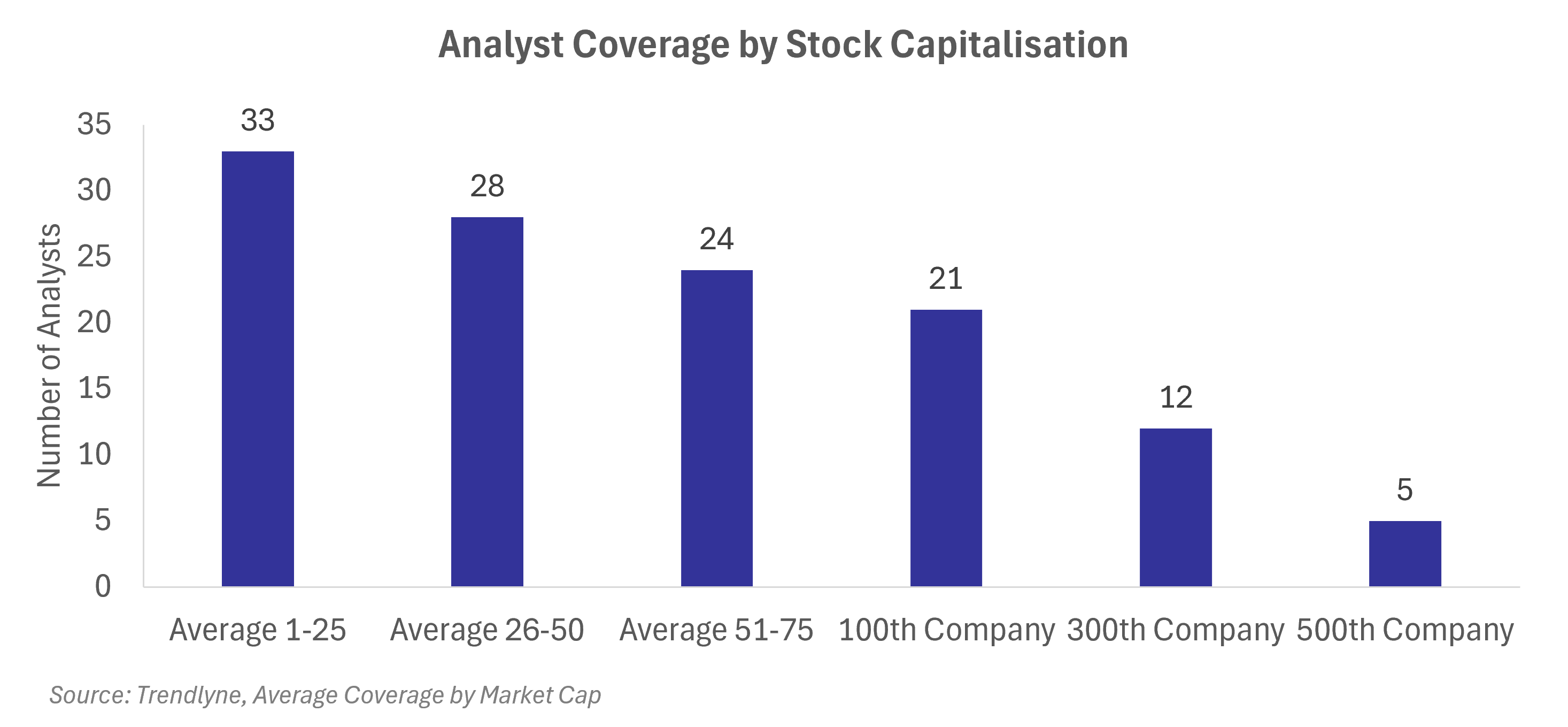
Local market knowledge may be an important consideration when evaluating Indian companies. Meeting company management, understanding promoter groups and analysing industry dynamics on the ground can provide insights that are difficult to capture from financial statements alone.
This decline in research coverage may create circumstances where fundamental stock selection can play a larger role than some more heavily researched markets.
What does the evidence show?
The historical evidence reflects these structural characteristics. Based on India Avenue research, 25 Indian flexi-cap and multi-cap funds with a full ten-year history produced average annual return of approximately 14.4% after fees over the period measured, compared with 12.5% for the MSCI India Index and 11.6% for the Nifty 50 Index. Results will vary and different time periods may produce different outcomes.
Each option covers a different part of the market. Flexi and Multi-Cap funds have a broader mandate to invest typically across large, mid and small companies1. The MSCI India Index consist of 165 of the largest companies by market capitalisation (as of 27/07/2026), and the Nifty 50 Index tracks the 50 largest listed companies.
1 Groww – Multi-Cap Funds vs Flexi-Cap Funds
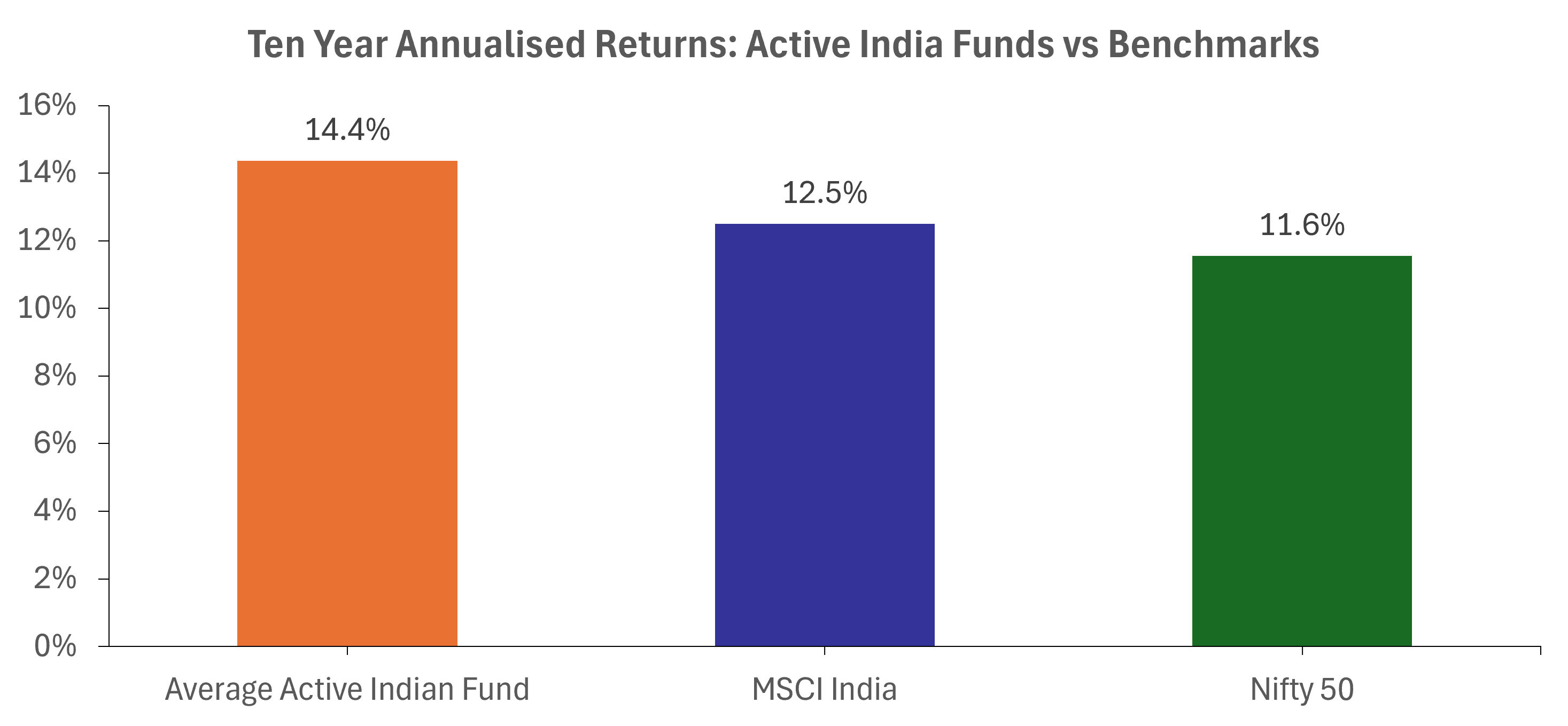
Source: Ace MF, MSCI. Ten years to 30 June 2026. Average of 25 flexi/multi-cap funds, after fund fees and before tax
The sample is intended to illustrate historical outcomes for a selection of active Indian equity funds over the period shown and may not be representative of all active managers, funds or investor experiences. The analysis is based on funds with a full ten-year performance history.
Active management cannot guarantee outperformance relative to passive strategies, and results differ across managers and market cycles. In markets such as India, where sector leadership, earnings dispersion, and corporate governance standards continue to evolve, active approaches may have greater scope to express conviction and manage risks. This potential is not assured and depends heavily on stock picking skill, process, and discipline.
Where India Avenue fits
The India Avenue Equity Fund (IAEF) is one option available to InvestNow investors seeking dedicated exposure to Indian equities
Rather than owning a small number of India’s largest companies, the Fund typically invests across 60–80 businesses spanning multiple sectors and market capitalisations. The portfolio maintains a structural bias towards mid and smaller companies, where research coverage is often less comprehensive. These companies may offer higher growth potential but can also involve additional risks and volatility.
This broader opportunity set is supported by locally based investment managers who conduct extensive bottom-up research, meet company management teams and continually assess the quality of businesses across India’s rapidly evolving economy.
The objective is simple: to provide investors with exposure to more of India’s opportunity set, rather than simply its largest companies.
Conclusion
India’s long-term economic outlook is supported by factors such as demographics, productivity growth, manufacturing development, infrastructure investment and domestic consumption, although future outcomes remain uncertain.
For New Zealand investors, however, the decision is not simply whether to invest in India. It is also how to access that market.
Global equity funds and emerging markets funds provide diversified exposure, although their allocation to India may be limited relative to dedicated India-focused strategies. Passive India ETFs offer low-cost exposure to the largest listed companies but are largely confined to businesses that have already entered benchmark indices.
A dedicated active India strategy seeks to provide broader exposure across sectors, industries and company sizes, combining rigorous fundamental research with local market expertise to identify businesses benefiting from India’s structural transformation.
As India continues its rise towards becoming one of the world’s largest economies, investors may find that the breadth of their exposure is just as important as the decision to invest there in the first place. Investors considering exposure to India may wish to consider not only whether they have exposure, but also the type and breadth of that exposure.
If you’d like to learn more about the India Avenue Equity Fund, please refer to the Product Disclosure Statement and other disclosure material available on India Avenue landing page on InvestNow.
Disclaimer:
- A copy of the PDS for the India Avenue Equity Fund (H Class) can be obtained by writing to India Avenue on IA@indianavenue.com.au or by visiting www.indiaavenue.com.au.
- Equity Trustees Limited is the Responsible Entity (ABN 46 004 031 298, AFSL 240975) for the India Avenue Equity Fund (H Class).
- This Note (‘Note’) has been produced by India Avenue Investment Management Limited (‘IAIM’) ABN 38 604 095 954, AFSL 478233 and has been prepared for informational and discussion purposes only. This does not constitute an offer to sell or a solicitation of an offer to purchase any security or financial product or service. Any such offer or solicitation shall be made only pursuant to a Product Disclosure Statement, Information Memorandum, or other offer document (collectively ‘Offer Document’) relating to an IAIM financial product or service.
- This Note does not constitute a part of any Offer Document issued by IAIM. The information contained in this Note may not be reproduced, used, or disclosed, in whole or in part, without prior written consent of IAIM.
- Past performance is not necessarily indicative of future results and no person guarantees the performance of any IAIM financial product or service or the amount or timing of any return from it. There can be no assurance that an IAIM financial product or service will achieve any targeted returns, that asset allocations will be met or that an IAIM financial product or service will be able to implement its investment strategy and investment approach or achieve its investment objective.
- Statements contained in this Note that are not historical facts are based on current expectations, estimates, projections, opinions and beliefs of IAIM. Such statements involve known and unknown risks, uncertainties and other factors, and undue reliance should not be placed thereon. Additionally, this Note may contain “forward-looking statements”. Actual events or results or the actual performance of an IAIM financial product or service may differ materially from those reflected or contemplated in such forward-looking statements. Any trademarks, logos, and service marks contained herein may be the registered and unregistered trademarks of their respective owners. Nothing contained herein should be construed as granting by implication, or otherwise, any license or right to use any trademark displayed without the written permission of the owner.
- Certain economic, market or company information contained herein has been obtained from published sources prepared by third parties. While such sources are believed to be reliable, neither IAIM nor any of its respective officers or employees assumes any responsibility for the accuracy or completeness of such information. None of IAIM or any of its respective officers or employees has made any representation or warranty, express or implied, with respect to the correctness, accuracy, reasonableness or completeness of any of the information contained in this and they expressly disclaim any responsibility or liability, therefore. No person, including IAIM has any responsibility to update any of the information provided in this Note.
- Neither this Note nor the provision of any Offer Document issued by IAIM is, and must not be regarded as, advice or a recommendation or opinion in relation to an IAIM financial product or service, or that an investment in an IAIM financial product or service is suitable for you or any other person. Neither this Note nor any Offer Document issued by IAIM considers your investment objectives, financial situation, and particular needs. In addition to carefully reading the relevant Offer Document issued by IAIM you should, before deciding whether to invest in an IAIM financial product or service, consider the appropriateness of investing or continuing to invest, having regard to your own objectives, financial situation, or needs. IAIM strongly recommends that you obtain independent financial, legal and taxation advice before deciding whether to invest in an IAIM financial product or service.
This information is provided by InvestNow Saving and Investment Service Limited (“InvestNow”). The information and any opinions in this publication are based on sources that InvestNow believes are reliable and accurate. InvestNow, its directors, officers and employees make no representations or warranties of any kind as to the accuracy or completeness of the information contained in this publication and disclaim liability for any loss, damage, cost or expense that may arise from any reliance on the information or any opinions, conclusions or recommendations contained in it, whether that loss or damage is caused by any fault or negligence on the part of InvestNow, or otherwise, except for any statutory liability which cannot be excluded. All opinions and market commentary reflect InvestNow’s judgment on the date of this publication and are subject to change without notice. This disclaimer extends to any entity that may distribute this publication. The information in this publication is not intended to be financial advice for the purposes of the Financial Markets Conduct Act 2013, as amended by the Financial Services Legislation Amendment Act 2019. In particular, in preparing this document, InvestNow did not take into account the investment objectives, financial situation and particular needs of any particular person. Professional investment advice from an appropriately qualified adviser is recommended before making any investment. All Investments involve risk. Examples of specific fund performance are for illustrative purposes only and are not intended as a recommendation. Any projections, scenarios, or modelling presented are illustrative only and are not forecasts or predictions of future performance. Past performance is not a reliable indicator of future results.



Leave A Comment