

Strong earnings, resilient economic activity and broader participation across sectors helped support global markets in August. Lewis Fowler, Portfolio Manager at Harbour Asset Management, explains the key themes that influenced markets during the month and considers what investors should be paying attention to now.
Economic Resilience Keeps Markets Moving Higher
Global share markets pushed higher in August as economic activity held up and companies continued to deliver on earnings. What could have been a difficult month, given ongoing tension in the Middle East and a firmer message on inflation from the US Federal Reserve, instead saw broader participation across sectors. Fixed income was more subdued, but the tone across risk assets was supportive.
Key market movements
- Global equities rebounded, with the MSCI ACWI (NZD unhedged) returning 2.0% and the NZD-hedged index 2.3%. Trailing 12-month returns remain healthy at 22.0% and 21.1% respectively.
- The New Zealand market was also up on the month, with the S&P/NZX 50 Gross Index (including imputation credits) up 1.7%. The S&P/ASX 200 rose 1.5% in Australian dollar terms, or 2.8% in NZD as our currency weakened.
- Fixed income returns were broadly flat. The Bloomberg NZ Bond Composite Index returned 0.1%, while the Bloomberg Global Aggregate Bond Index (hedged to NZD) ended the month at 0.0%.
What drove markets in August
Technology regained momentum after July’s sell-off, although leadership was broader than semiconductors, with software companies also benefiting from solid results. Resources joined the advance as precious and industrial metals moved higher. The backdrop was not entirely benign, with tension in the Middle East keeping oil markets unsettled. Corporate fundamentals nevertheless proved resilient enough for equities to absorb both the geopolitical uncertainty and higher bond yields.
The message from Jackson Hole was less reassuring for bond investors. Federal Reserve Chair Kevin Warsh made clear that inflation remains the priority and that stronger evidence of progress towards target is needed before the Fed can contemplate a softer stance. That landed against an economy still performing well, leaving the Fed with less reason to look through inflation than some other central banks.
China continues to operate at two speeds. Exports and industrial activity are benefiting from AI-related demand, but the household economy remains subdued as falling property prices and employment concerns weigh on confidence. For New Zealand the distinction matters. Weak Chinese consumption does not translate neatly into weak demand for every export, and appetite for high-quality protein remains supported by a growing middle class.
Closer to home, restrictive monetary policy is becoming more visible in Australia, where housing activity and discretionary spending are slowing while persistent core inflation limits the RBA’s room to respond. New Zealand’s recovery is uneven. Exports, tourism and education remain the brighter areas, and business investment is beginning to recover, but households are still cautious. The RBNZ’s early-September OCR increase was accompanied by a more measured signal on further tightening, reflecting the tension between inflation risk and weak domestic activity.
The AI cycle and an exceptional earnings season
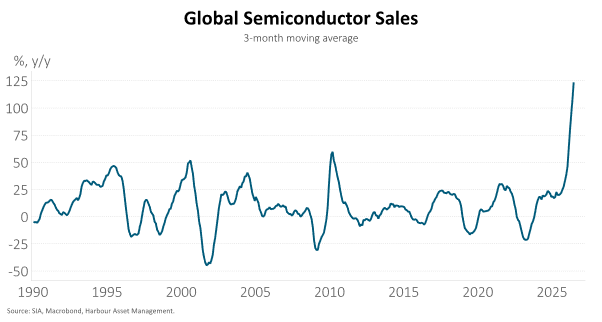
The surge in global semiconductor sales reflects the extraordinary scale of AI-related investment. NVIDIA’s GPUs remain the critical compute engine behind AI models, while memory suppliers such as SK Hynix have become equally important as demand for High Bandwidth Memory (HBM) accelerates. What began as a GPU story has evolved into a broader semiconductor cycle encompassing memory, storage, networking and advanced packaging. Hyperscaler capital expenditure growth is still climbing, and as NVIDIA’s Jensen Huang recently noted, demand continues to outstrip supply in key AI components, with production bottlenecks more likely to be the limiting factor for sales than end-user appetite.
NVIDIA’s late-August result closed out an exceptional US Q2 earnings season. The company delivered profit of US$59.7 billion and revenue of US$96.2 billion, both more than double the same quarter last year, alongside guidance for around 70% growth in the coming year. The hyperscalers again did much of the heavy lifting, with the “Magnificent 7” reporting aggregate earnings growth of 118% for the quarter, although both Alphabet and Amazon reported sizeable unrealised investment gains. More encouraging was the breadth beneath the headline. Ten of the eleven S&P 500 sectors reported year-on-year earnings growth in Q2 and nine of them delivered double-digit gains.
Where we go from here
Economic resilience and solid earnings have allowed global markets to withstand higher bond yields so far, which has surprised many investors. Coming into the year the worry was that tighter monetary policy and elevated valuations would constrain returns, yet earnings growth has remained strong and has broadened. Small caps outperformed in August and earnings strength extended into areas such as energy and materials. Markets driven by a wider group of companies and sectors are generally healthier than those dependent on a handful of leaders.
The New Zealand earnings season provided cause for some confidence on select company prospects, although there is little evidence of a broad domestic recovery. Cost reduction and productivity programmes are beginning to produce better operating leverage, balance sheets remain sound, and dividend announcements were supportive. Management guidance was still conservative. With market earnings expectations modest, some of that caution may eventually prove excessive, particularly for businesses already doing the operational work needed to lift returns.
Australia looks less straightforward. Resources and selected healthcare and technology names retain useful earnings support, while domestically exposed companies are contending with slower housing activity, cautious consumers and higher funding costs. Reporting season showed that headline earnings growth can obscure a weaker underlying trend when much of the improvement is concentrated in mining.
On balance the message from this month is not that everything is settled, but that underlying corporate fundamentals remain supportive at a time when the macro headlines are noisy. Higher bond yields do raise the hurdle for valuations, but they may also reflect firmer growth rather than inflation alone. Staying diversified as performance broadens, and paying attention to where earnings are actually being generated remains a sensible approach in this environment.
If you want to see which Harbour funds are available on InvestNow, plus read any other opinion or commentary pieces from Lewis and the team at Harbour Asset Management, please visit their page on our website.

Strong earnings, resilient economic activity and broader participation across sectors helped support global markets in August. Lewis Fowler, Portfolio Manager at Harbour Asset Management, explains the key themes that influenced markets during the month and considers what investors should be paying attention to now.
Economic Resilience Keeps Markets Moving Higher
Global share markets pushed higher in August as economic activity held up and companies continued to deliver on earnings. What could have been a difficult month, given ongoing tension in the Middle East and a firmer message on inflation from the US Federal Reserve, instead saw broader participation across sectors. Fixed income was more subdued, but the tone across risk assets was supportive.
Key market movements
- Global equities rebounded, with the MSCI ACWI (NZD unhedged) returning 2.0% and the NZD-hedged index 2.3%. Trailing 12-month returns remain healthy at 22.0% and 21.1% respectively.
- The New Zealand market was also up on the month, with the S&P/NZX 50 Gross Index (including imputation credits) up 1.7%. The S&P/ASX 200 rose 1.5% in Australian dollar terms, or 2.8% in NZD as our currency weakened.
- Fixed income returns were broadly flat. The Bloomberg NZ Bond Composite Index returned 0.1%, while the Bloomberg Global Aggregate Bond Index (hedged to NZD) ended the month at 0.0%.
What drove markets in August
Technology regained momentum after July’s sell-off, although leadership was broader than semiconductors, with software companies also benefiting from solid results. Resources joined the advance as precious and industrial metals moved higher. The backdrop was not entirely benign, with tension in the Middle East keeping oil markets unsettled. Corporate fundamentals nevertheless proved resilient enough for equities to absorb both the geopolitical uncertainty and higher bond yields.
The message from Jackson Hole was less reassuring for bond investors. Federal Reserve Chair Kevin Warsh made clear that inflation remains the priority and that stronger evidence of progress towards target is needed before the Fed can contemplate a softer stance. That landed against an economy still performing well, leaving the Fed with less reason to look through inflation than some other central banks.
China continues to operate at two speeds. Exports and industrial activity are benefiting from AI-related demand, but the household economy remains subdued as falling property prices and employment concerns weigh on confidence. For New Zealand the distinction matters. Weak Chinese consumption does not translate neatly into weak demand for every export, and appetite for high-quality protein remains supported by a growing middle class.
Closer to home, restrictive monetary policy is becoming more visible in Australia, where housing activity and discretionary spending are slowing while persistent core inflation limits the RBA’s room to respond. New Zealand’s recovery is uneven. Exports, tourism and education remain the brighter areas, and business investment is beginning to recover, but households are still cautious. The RBNZ’s early-September OCR increase was accompanied by a more measured signal on further tightening, reflecting the tension between inflation risk and weak domestic activity.
The AI cycle and an exceptional earnings season
The surge in global semiconductor sales reflects the extraordinary scale of AI-related investment. NVIDIA’s GPUs remain the critical compute engine behind AI models, while memory suppliers such as SK Hynix have become equally important as demand for High Bandwidth Memory (HBM) accelerates. What began as a GPU story has evolved into a broader semiconductor cycle encompassing memory, storage, networking and advanced packaging. Hyperscaler capital expenditure growth is still climbing, and as NVIDIA’s Jensen Huang recently noted, demand continues to outstrip supply in key AI components, with production bottlenecks more likely to be the limiting factor for sales than end-user appetite
NVIDIA’s late-August result closed out an exceptional US Q2 earnings season. The company delivered profit of US$59.7 billion and revenue of US$96.2 billion, both more than double the same quarter last year, alongside guidance for around 70% growth in the coming year. The hyperscalers again did much of the heavy lifting, with the “Magnificent 7” reporting aggregate earnings growth of 118% for the quarter, although both Alphabet and Amazon reported sizeable unrealised investment gains. More encouraging was the breadth beneath the headline. Ten of the eleven S&P 500 sectors reported year-on-year earnings growth in Q2 and nine of them delivered double-digit gains.
Where we go from here
Economic resilience and solid earnings have allowed global markets to withstand higher bond yields so far, which has surprised many investors. Coming into the year the worry was that tighter monetary policy and elevated valuations would constrain returns, yet earnings growth has remained strong and has broadened. Small caps outperformed in August and earnings strength extended into areas such as energy and materials. Markets driven by a wider group of companies and sectors are generally healthier than those dependent on a handful of leaders.
The New Zealand earnings season provided cause for some confidence on select company prospects, although there is little evidence of a broad domestic recovery. Cost reduction and productivity programmes are beginning to produce better operating leverage, balance sheets remain sound, and dividend announcements were supportive. Management guidance was still conservative. With market earnings expectations modest, some of that caution may eventually prove excessive, particularly for businesses already doing the operational work needed to lift returns.
Australia looks less straightforward. Resources and selected healthcare and technology names retain useful earnings support, while domestically exposed companies are contending with slower housing activity, cautious consumers and higher funding costs. Reporting season showed that headline earnings growth can obscure a weaker underlying trend when much of the improvement is concentrated in mining.
On balance the message from this month is not that everything is settled, but that underlying corporate fundamentals remain supportive at a time when the macro headlines are noisy. Higher bond yields do raise the hurdle for valuations, but they may also reflect firmer growth rather than inflation alone. Staying diversified as performance broadens, and paying attention to where earnings are actually being generated remains a sensible approach in this environment.
If you want to see which Harbour funds are available on InvestNow, plus read any other opinion or commentary pieces from Lewis and the team at Harbour Asset Management, please visit their page on our website.
Disclaimer:
This publication is provided for general information purposes only. The information provided is not intended to be financial advice. The information provided is given in good faith and has been prepared from sources believed to be accurate and complete as at the date of issue, but such information may be subject to change. Past performance is not indicative of future results and no representation is made regarding future performance of the Funds. No person guarantees the performance of any funds managed by Harbour Asset Management Limited.
Harbour Asset Management Limited (Harbour) is the issuer of the Harbour Investment Funds. A copy of the Product Disclosure Statement is available at https://www.harbourasset.co.nz/our-funds/investor-documents/. Harbour is also the issuer of Hunter Investment Funds (Hunter). A copy of the relevant Product Disclosure Statement is available at https://hunterinvestments.co.nz/resources/. Please find our quarterly Fund updates, which contain returns and total fees during the previous year on those Harbour and Hunter websites. Harbour also manages wholesale unit trusts. To invest as a wholesale investor, investors must fit the criteria as set out in the Financial Markets Conduct Act 2013.
Leave A Comment