
Rising bond yields, elevated oil prices and ongoing conflict in the Middle East shaped market sentiment in September. In this month’s Market Wrap-Up, Brett Moffat, Senior Consultant at Russell Investments, explains the key developments influencing global markets and considers what investors should be paying attention to as inflation and interest rate expectations continue to evolve.
Oil, Inflation and the Return of Bond Market Influence
Global energy price volatility shaped market performance in September, with rises and falls aligned with developments in the conflict in the Middle East, which pushed oil prices higher. While equities have dominated conversations, volatility in fixed income markets underpin a general unease in macroeconomic conditions.
Key market movements
- Global equity returns varied depending on currency hedging in September, with the MSCI ACWI returning 3.6% in unhedged NZD terms and -0.8% when hedged to NZD. Trailing 12-month returns were strong at 20.0% and 15.9%, respectively.
- New Zealand and Australian equities declined over the month. The S&P/NZX 50 Gross Index fell 0.6%, while the S&P/ASX 300 fell 2.4% in Australian dollar terms, or 1.4% in NZD.
- Fixed income returns were negative. The Bloomberg NZBond Composite 0+ Yr Index returned 1.0%, while the Bloomberg Global Aggregate Float Adjusted Bond Index (hedged to NZD) returned -1.8%.
What drove markets in September
Global bonds are experiencing an increasing sell-off as investors become concerned about rising yields. The US Treasury 10-year yield rose to 5.11% late in the month, its highest level since 2007. Across the ditch, Australia has also seen some significant repricing with the 10-year government bond yield rising to 5.4% in September, up from 4.6% in early July. There are several factors driving the shift, starting with continued strength of the US economy. September business activity accelerated at the fastest pace in five years, with the Atlanta Federal Reserve estimate showing annualised growth of more than 5%. Oil prices climbed sharply in the waning days of the month as peace talks stalled, adding to general inflationary pressures.
New Zealand bonds, by contrast, have outperformed due to a combination of factors including expectations that relatively restrained economic growth will lead the Reserve Bank of New Zealand to hold rates lower for longer while international equivalents increase them.
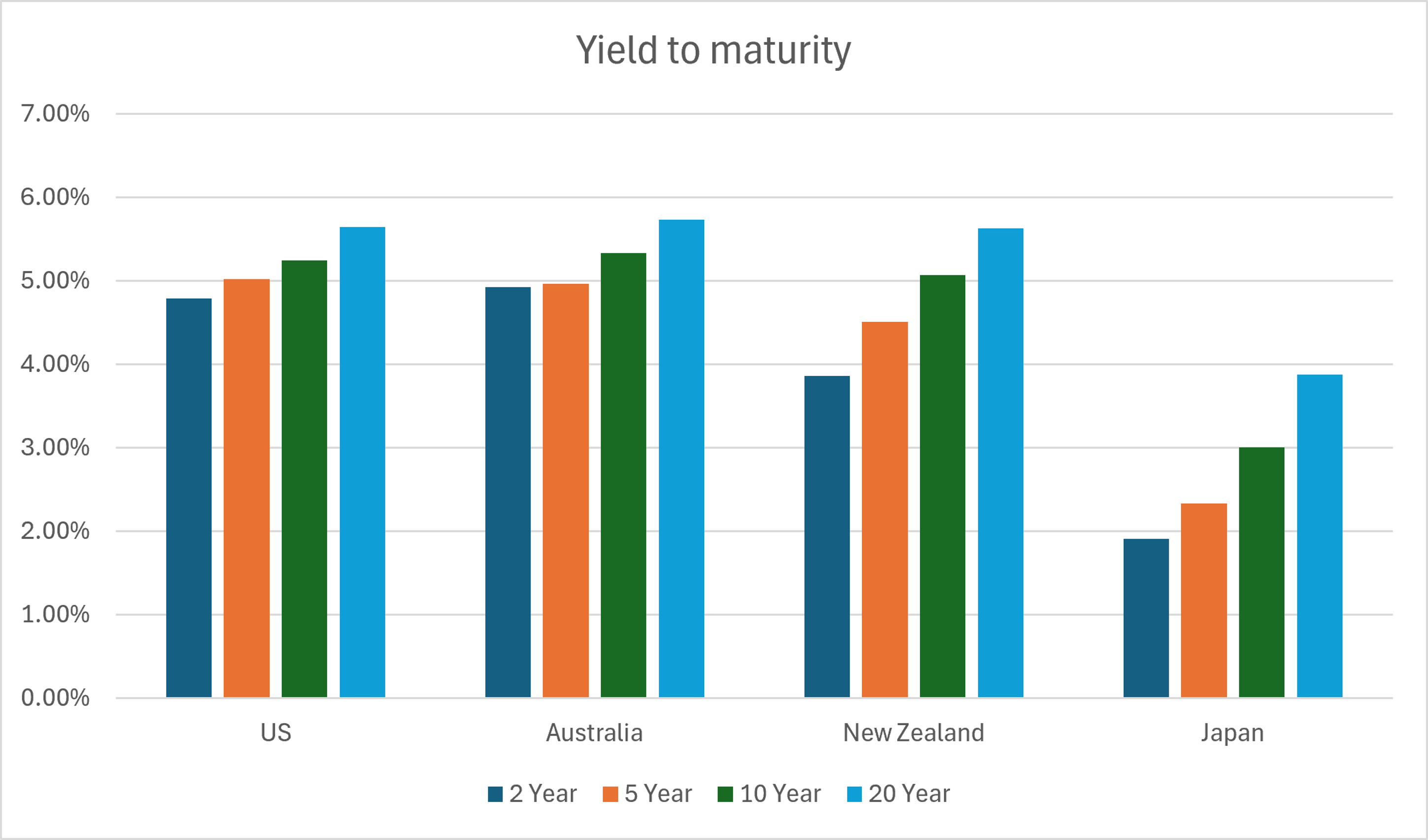
Source: Trading Economics
Increased borrowing costs are weighing on different industries, particularly those with significant borrowing requirements including AI hyperscalers and related suppliers like chipmakers that have driven market growth over the last year. As borrowing rates go up, the associated costs for these companies go up as well. Despite this, large-cap tech and semiconductor companies have dominated market momentum while legacy tech including software has lagged due to concerns about being replaced by catch-all AI solutions.
Global inflation continues to be a concern, driving central bank actions. New Zealand is no exception, with Q2 2026 inflation coming in significantly higher than the previous quarter’s report, up to 4.1% through June from 3.1% through March.
Inflation in the second quarter is now higher than Q1 2024. Transportation costs have driven the change, with petrol up 27.5% and other vehicle fuel and lubricants up more than 70%. Housing was also a driver, rising 3.6% in the quarter due to underlying electricity prices rising more than 12%. While prices are still rising, inflation moderated for food, at 2.8% compared to 4.0% in the previous quarter.
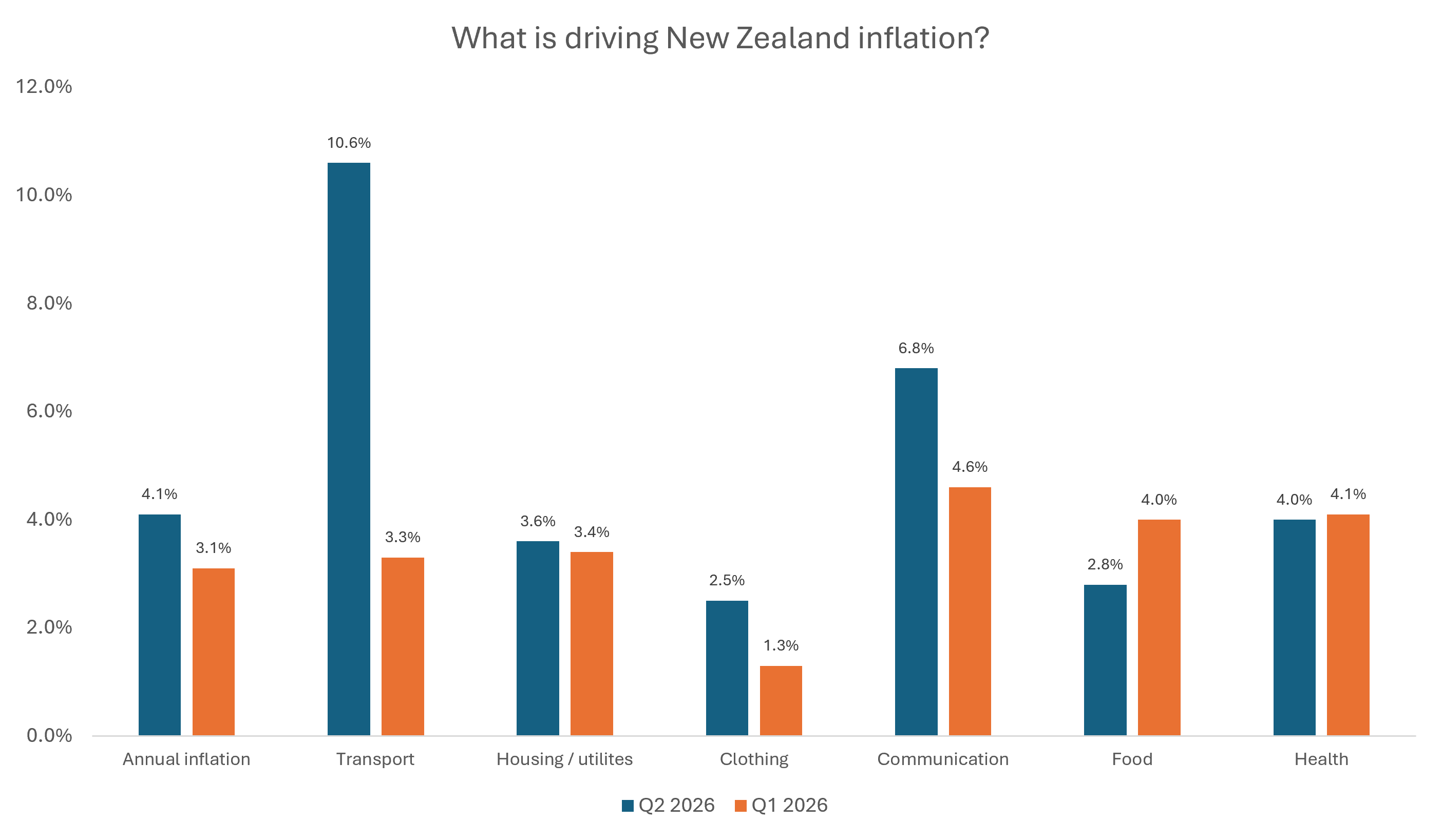
Source: Statistics New Zealand
New Zealand’s annual gross domestic product (GDP) – the total value of finished goods and services produced in a specified time period – slowed in the most recent report. Stats NZ figures show that the economy grew 0.2% in the June 2026 quarter. While the number may be small, there are two positive aspects to it. First, GDP beat the flat outcome that the Reserve Bank of New Zealand (RBNZ) had set as its expectation and GDP avoided contraction. Second, annual growth is at 2.6%, which is the strongest pace since June 2023.
Construction was the strongest contributor to GDP growth, rising 2.7% for the quarter after a protracted period of contraction. Goods-production sectors were also reasonably strong due to external demand while the services sector was mixed, and retail (and other discretionary spending) was weaker as spending has been constricted by oil price increases. Generally, however, it appears that the domestic economy is handling the flow-on effects of the conflict in the Middle East well.
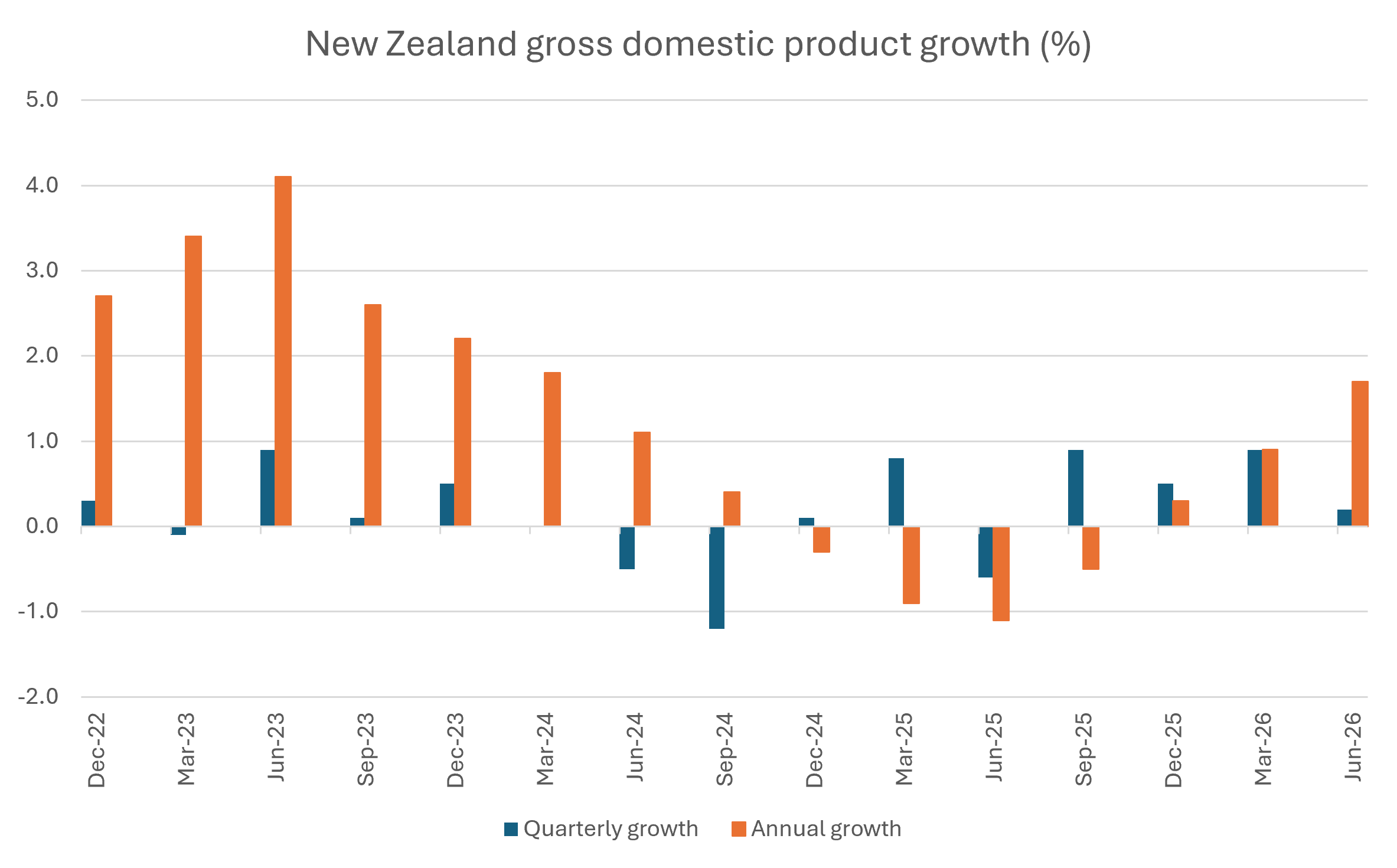
Source: Statistics New Zealand
What we’re expecting going forward
Over the quarter, markets were challenged with global bond yields rising and central banks turning hawkish. Oil prices have remained elevated due to lingering concerns about further escalation in the Middle East. In most regions, like the US, the increase in bond yields has mostly been driven by increased policy uncertainty and real yields from higher growth expectations. Inflation has picked up slightly and has been dominated by supply side effects and secular factors (tariffs, energy, AI).
Conversely, in Australia, policy uncertainty has increased yields, but inflation has also been stickier. Despite this, equities and notably US mega caps remained resilient over the quarter supported by increasing economic growth expectations and strong corporate earnings. Small cap equities, high duration bonds (e.g. Government) and real assets struggled over the quarter with rising bond yields.
Within credit, despite a significant increase in debt supply from US technology firms, credit spreads remained fairly stable as corporate balance sheets remained strong.
Our composite contrarian indicator, which measures pessimism and euphoria in markets, has remained fairly neutral. We still see the cycle as positive going forward, with recession risk at average levels, financial conditions still reasonably supportive and productivity gains likely to support future growth. We are conscious of possible risks to sticker inflation, notably a reignition of the middle east conflict weighing on global oil supply.
Our exposure to growth is modestly above benchmark, paired with exposure to diversifying assets such as hedge funds and unlisted growth. We are also now moderately overweight duration as we have added to global duration with increased bond yields. Regionally, we retain an overweight to US and Emerging Market equities. We are slightly underweight Australian equities as the growth outlook is more subdued and interest rate increases are weighing on the consumer and the property market.
For fixed income assets, we believe Australian government bonds still offer value versus global; however, given the convergence of yields, we added to global duration in late September. We expect that government bonds should act as portfolio diversifiers if the growth outlook deteriorates. Within credit, we are slightly underweight as IG spreads remain tight and offer poor risk reward.
Whereas infrastructure and commodities are alternative investment opportunities that may benefit from their resilience if inflation becomes elevated.
If you want to see which Russell Investments funds are available on InvestNow, plus read any other opinion or commentary pieces from Brett and the team at Russell Investments, please visit their page on our website.

Rising bond yields, elevated oil prices and ongoing conflict in the Middle East shaped market sentiment in September. In this month’s Market Wrap-Up, Brett Moffat, Senior Consultant at Russell Investments, explains the key developments influencing global markets and considers what investors should be paying attention to as inflation and interest rate expectations continue to evolve.
Oil, Inflation and the Return of Bond Market Influence
Global energy price volatility shaped market performance in September, with rises and falls aligned with developments in the conflict in the Middle East, which pushed oil prices higher. While equities have dominated conversations, volatility in fixed income markets underpin a general unease in macroeconomic conditions.
Key market movements
- Global equity returns varied depending on currency hedging in September, with the MSCI ACWI returning 3.6% in unhedged NZD terms and -0.8% when hedged to NZD. Trailing 12-month returns were strong at 20.0% and 15.9%, respectively.
- New Zealand and Australian equities declined over the month. The S&P/NZX 50 Gross Index fell 0.6%, while the S&P/ASX 300 fell 2.4% in Australian dollar terms, or 1.4% in NZD.
- Fixed income returns were negative. The Bloomberg NZBond Composite 0+ Yr Index returned 1.0%, while the Bloomberg Global Aggregate Float Adjusted Bond Index (hedged to NZD) returned -1.8%.
What drove markets in September
Global bonds are experiencing an increasing sell-off as investors become concerned about rising yields. The US Treasury 10-year yield rose to 5.11% late in the month, its highest level since 2007. Across the ditch, Australia has also seen some significant repricing with the 10-year government bond yield rising to 5.4% in September, up from 4.6% in early July. There are several factors driving the shift, starting with continued strength of the US economy. September business activity accelerated at the fastest pace in five years, with the Atlanta Federal Reserve estimate showing annualised growth of more than 5%. Oil prices climbed sharply in the waning days of the month as peace talks stalled, adding to general inflationary pressures.
New Zealand bonds, by contrast, have outperformed due to a combination of factors including expectations that relatively restrained economic growth will lead the Reserve Bank of New Zealand to hold rates lower for longer while international equivalents increase them.
Source: Trading Economics
Increased borrowing costs are weighing on different industries, particularly those with significant borrowing requirements including AI hyperscalers and related suppliers like chipmakers that have driven market growth over the last year. As borrowing rates go up, the associated costs for these companies go up as well. Despite this, large-cap tech and semiconductor companies have dominated market momentum while legacy tech including software has lagged due to concerns about being replaced by catch-all AI solutions.
Global inflation continues to be a concern, driving central bank actions. New Zealand is no exception, with Q2 2026 inflation coming in significantly higher than the previous quarter’s report, up to 4.1% through June from 3.1% through March.
Inflation in the second quarter is now higher than Q1 2024. Transportation costs have driven the change, with petrol up 27.5% and other vehicle fuel and lubricants up more than 70%. Housing was also a driver, rising 3.6% in the quarter due to underlying electricity prices rising more than 12%. While prices are still rising, inflation moderated for food, at 2.8% compared to 4.0% in the previous quarter.
Source: Statistics New Zealand
New Zealand’s annual gross domestic product (GDP) – the total value of finished goods and services produced in a specified time period – slowed in the most recent report. Stats NZ figures show that the economy grew 0.2% in the June 2026 quarter. While the number may be small, there are two positive aspects to it. First, GDP beat the flat outcome that the Reserve Bank of New Zealand (RBNZ) had set as its expectation and GDP avoided contraction. Second, annual growth is at 2.6%, which is the strongest pace since June 2023.
Construction was the strongest contributor to GDP growth, rising 2.7% for the quarter after a protracted period of contraction. Goods-production sectors were also reasonably strong due to external demand while the services sector was mixed, and retail (and other discretionary spending) was weaker as spending has been constricted by oil price increases. Generally, however, it appears that the domestic economy is handling the flow-on effects of the conflict in the Middle East well.
Source: Statistics New Zealand
What we’re expecting going forward
Over the quarter, markets were challenged with global bond yields rising and central banks turning hawkish. Oil prices have remained elevated due to lingering concerns about further escalation in the Middle East. In most regions, like the US, the increase in bond yields has mostly been driven by increased policy uncertainty and real yields from higher growth expectations. Inflation has picked up slightly and has been dominated by supply side effects and secular factors (tariffs, energy, AI).
Conversely, in Australia, policy uncertainty has increased yields, but inflation has also been stickier. Despite this, equities and notably US mega caps remained resilient over the quarter supported by increasing economic growth expectations and strong corporate earnings. Small cap equities, high duration bonds (e.g. Government) and real assets struggled over the quarter with rising bond yields.
Within credit, despite a significant increase in debt supply from US technology firms, credit spreads remained fairly stable as corporate balance sheets remained strong.
Our composite contrarian indicator, which measures pessimism and euphoria in markets, has remained fairly neutral. We still see the cycle as positive going forward, with recession risk at average levels, financial conditions still reasonably supportive and productivity gains likely to support future growth. We are conscious of possible risks to sticker inflation, notably a reignition of the middle east conflict weighing on global oil supply.
Our exposure to growth is modestly above benchmark, paired with exposure to diversifying assets such as hedge funds and unlisted growth. We are also now moderately overweight duration as we have added to global duration with increased bond yields. Regionally, we retain an overweight to US and Emerging Market equities. We are slightly underweight Australian equities as the growth outlook is more subdued and interest rate increases are weighing on the consumer and the property market.
For fixed income assets, we believe Australian government bonds still offer value versus global; however, given the convergence of yields, we added to global duration in late September. We expect that government bonds should act as portfolio diversifiers if the growth outlook deteriorates. Within credit, we are slightly underweight as IG spreads remain tight and offer poor risk reward.
Whereas infrastructure and commodities are alternative investment opportunities that may benefit from their resilience if inflation becomes elevated.
If you want to see which Russell Investments funds are available on InvestNow, plus read any other opinion or commentary pieces from Brett and the team at Russell Investments, please visit their page on our website.
Disclaimer: The information contained in this publication was prepared by Russell Investment Group Limited. It has been compiled from sources considered to be reliable, but is not guaranteed. This publication provides general information only and should not be relied upon in making an investment decision. Before making an investment decision, you need to consider whether this information is appropriate to your objectives, financial situation and needs. All investments are subject to risks. Past performance is not a reliable indicator of future performance.
Copyright © 2026 Russell Investments. All rights reserved. This information contained in this publication is proprietary and may not be reproduced, transferred, or distributed in any form without prior written permission from Russell Investments.
On July 2, 2026, Russell Investments Group, Ltd. (“Russell Investments”) entered into a definitive agreement and plan of merger (the “Transaction”) pursuant to which Russell Investments will be acquired by a consortium led by B Capital Group Management, L.P. that includes California Public Employees Retirement System. The Transaction is expected to close by the end of Q1 2027, subject to the receipt of regulatory approvals and other customary closing conditions.
Leave A Comment