
KiwiSaver Tax Explained: Why timing matters more than you think
Article written by Jason Choy, InvestNow Senior Portfolio Manager – May 2026

Most New Zealanders know KiwiSaver is taxed.
Tax is a standard part of investing, but how it’s applied within KiwiSaver – and how it can shape long-term outcomes – isn’t always widely understood
Two features of New Zealand’s retirement system are particularly important in this regard. The first is the overall Taxed–Taxed–Exempt (TTE) structure that applies to KiwiSaver. The second is how investment earnings are taxed each year, particularly for offshore assets through the Foreign Investment Fund (FIF) regime.
Neither operates in isolation. But together, they influence how much of your money stays invested – and how effectively it can compound over time.
New Zealand vs Overseas Retirement Tax Structures
New Zealand applies what’s known as a TTE model, where:
- Contributions are Taxed
- Investment earnings are Taxed
- Withdrawals are generally Tax Exempt.
In contrast, many other developed countries use variations of an Exempt–Exempt–Taxed (EET) model, where:
- Contributions are tax-advantaged or Exempt
- Investment earnings are largely tax-advantaged or Exempt
- Withdrawals are Taxed.
Both systems still involve taxing your investments – after all nothing’s certain in life except death and taxes. The key difference is when that tax is applied.
Under New Zealand’s TTE approach, tax is applied both before and throughout the investing journey. This reduces the amount of capital that remains invested and able to generate returns over time.
In contrast, many overseas retirement systems defer most of the tax until withdrawal, allowing a larger pool of savings to stay invested for longer. International analysis – including the OECD’s recent review of New Zealand – suggests that approaches which reduce the tax drag during the accumulation phase can better support stronger long-term accumulation and are worth considering over time.
How New Zealand’s ‘TTE’ structure works in practice
To understand how these structural differences can flow through to your KiwiSaver portfolio, it helps to look at each part of the New Zealand system in turn.
The first “T” – contributions
KiwiSaver contributions are generally made from after-tax income.
This means the first tax hurdle investors face – which applies to their own contributions – is their marginal income tax rate, which shaves off up to 39% in tax. Employer contributions are also taxed (via the Employer Superannuation Contribution Tax) at broadly similar marginal rates depending on income levels.
Outside of employer contributions and the annual government contribution of $260.72, there are currently no additional tax incentives to contribute more into KiwiSaver. This is notable given KiwiSaver’s purpose as a long-term retirement savings vehicle.
In practice, this can influence behaviour at the margin. For some investors, contributing beyond the minimum required to receive employer and government contributions may be less compelling, particularly when the same underlying investments can often be accessed outside KiwiSaver at the same cost but without the withdrawal restrictions.
This contrasts with many overseas retirement schemes, which typically include tax-advantaged contribution structures designed to encourage higher levels of savings. That distinction matters, because it directly influences how much capital enters the system in the first place – and therefore how much has the opportunity to compound over time.
The second “T” – investment earnings
The second “T” is where the impact on compounding becomes more pronounced.
KiwiSaver portfolios are increasingly invested in globally diversified assets and international shares in particular, which means a significant portion of returns are subject to the Foreign Investment Fund (FIF) regime.
Under the FIF regime, KiwiSaver portfolios are effectively taxed on a deemed return of 5% of their offshore share investments each year, regardless of the actual returns generated or whether gains have been realised. This deemed income is then taxed at the investor’s Prescribed Investor Rate, up to a maximum of 28%.
The FIF approach provides a relatively simple and consistent way to tax globally diversified portfolios. In periods where returns exceed 5%, it can also result in less tax being paid than if actual gains were taxed.
However, this also means that tax is payable even when international share returns are lower than 5% or negative altogether.
The 5% annual ‘deemed’ return that applies irrespective of actual gains or losses means that a FIF tax bill is payable each and every year you’re invested in offshore shares. Importantly in a KiwiSaver context, because this tax is generally deducted automatically from the portfolio each year, it reduces the amount that remains invested.
Over time, this could create a compounding drag – one that may not be obvious year to year, but can have a meaningful impact over the long-term. However, this does not reflect all KiwiSaver portfolios, which are typically diversified and may include assets taxed differently, including the impact of the capped PIR, which may result in different outcomes in practice.
The final “E” – withdrawals
One advantage of New Zealand’s system is that withdrawals are generally tax-free.
This provides simplicity and certainty at retirement. However, this is by no means a free lunch, as it simply reflects the fact that tax has already been applied earlier – both before money is invested and throughout the investment period.
Why this matters for long-term outcomes
Individually, each of these features may seem small.
But together, they mean that:
- less money enters the portfolio upfront
- some investment returns are taxed each year
- and the overall balance is gradually reduced along the way
Over a 30–45 year investment horizon, these small annual differences can compound into materially different outcomes.
TTE and EET in action
To illustrate this, we modelled a simplified KiwiSaver scenario:
- Salary: $100,000 (constant over time)
- Contributions: 4% employee + 4% employer each year
- Investment period: age 20 to 65
- Return: 7% per annum (after fees before tax)
- Portfolio: fully globally diversified shares (FIF applies throughout)
- Tax: 33% marginal rate and 28% PIR
We then compared:
- A TTE-style system, where contributions are taxed and investment returns are reduced each year by tax (including FIF)
- A tax-deferred system, where contributions and returns are not taxed during the accumulation phase, but the investor’s marginal tax rate is applied at withdrawal
TTE vs EET KiwiSaver Portfolio Balance Comparison (After Tax)
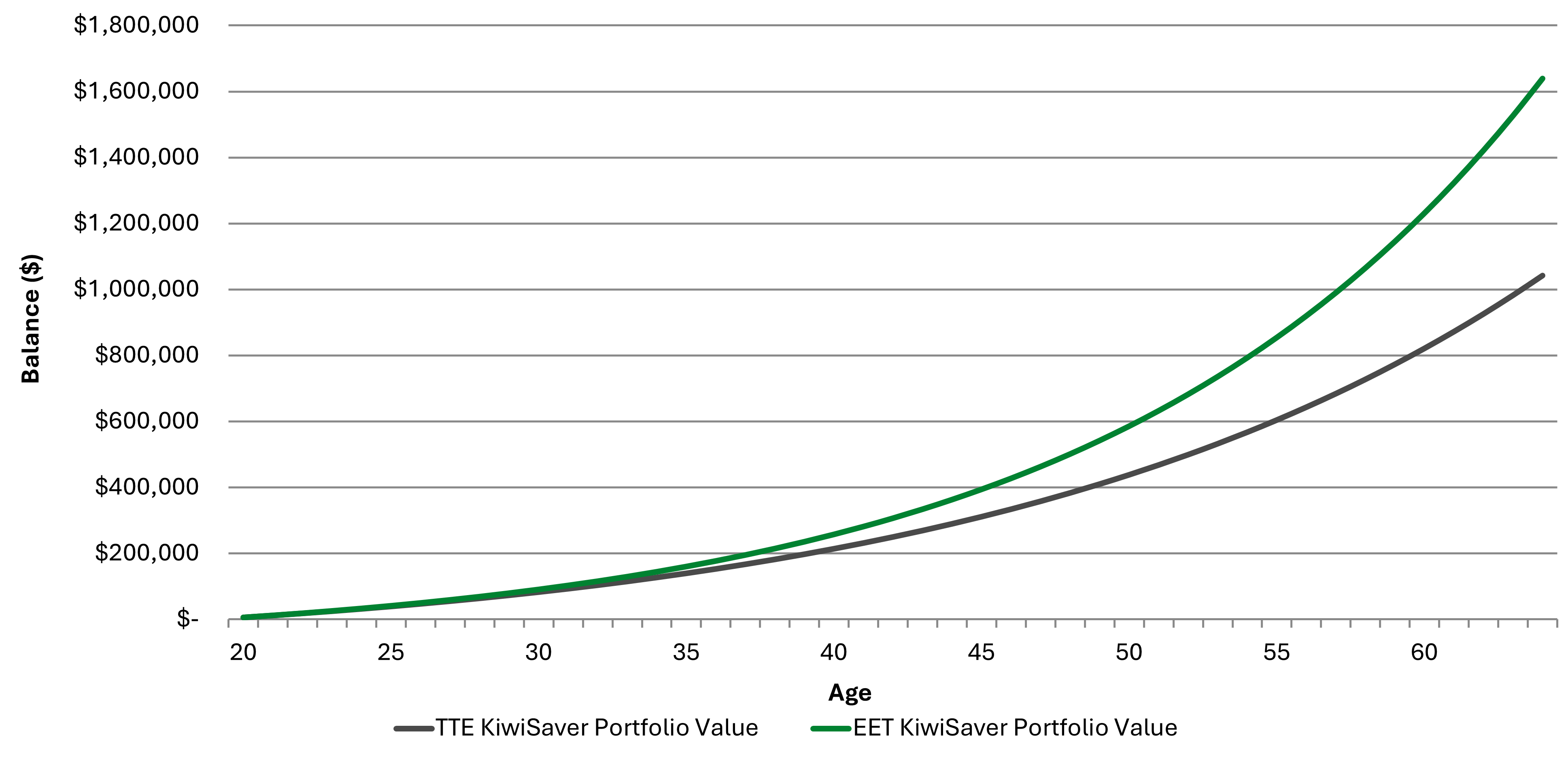
Under these assumptions, the tax-deferred approach produces a higher final after-tax portfolio balance.
The difference is not driven by better performance from the underlying investments, but by more of the portfolio remaining invested and compounding over time.
A second perspective: total tax collected
The model also highlights a second, less obvious outcome.
Because the tax-deferred approach results in a larger overall pre-tax portfolio, the eventual tax applied at withdrawal can also be higher in absolute term.
TTE vs EET Cumulative Tax Revenue Comparison
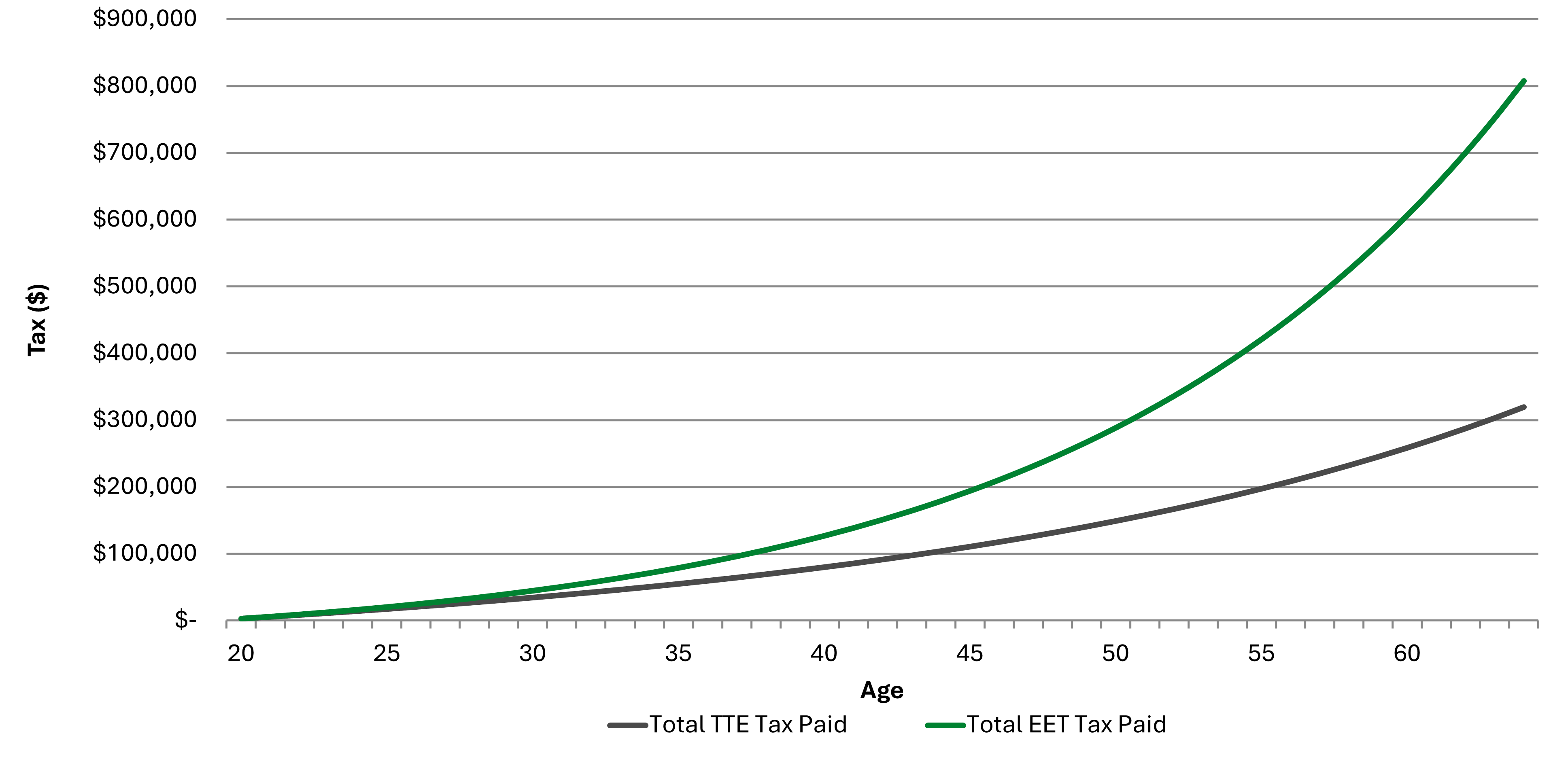
Under the same simplified assumptions, it results in more than double the total tax collected under the deferral model over the 45 year working lifetime of the KiwiSaver member.
Important considerations
Note that this analysis is a simplified illustration based on a number of assumptions, including a constant salary, consistent investment returns, fixed tax rates, and does not account for the time value of money.
In practice, returns can vary year-to-year, tax rules are more nuanced and depend on the nature of the underlying assets, and any real-world policy may not involve a perfectly clean exemption during accumulation and full taxation at withdrawal. There are also important fiscal considerations, including the timing of tax revenue and broader economic impacts.
However, what this does highlight is how different tax settings can influence saving and compounding outcomes – particularly at the contribution and investment return layer.
Final thought
KiwiSaver remains one of the most powerful tools available to New Zealand investors.
But the way it is taxed has a direct impact on how effectively long-term savings can grow.
As highlighted in international research, including the OECD’s recent review of New Zealand, many developed countries take a markedly different approach: deferring tax to allow savings to remain invested and better compound over time. While tax is ultimately still inevitable, small upfront reductions in tax can add up to materially different outcomes over a lifetime.
This is not just about investor outcomes either. Allowing savings to grow to larger balances can also support higher overall savings, deeper capital markets, and a broader tax base over time.
As New Zealand heads into an election cycle where retirement policy is back in focus, this is an area worth careful consideration.
At its core, the objective is simple – to remove unnecessary barriers and better enable long-term savings to do what they are designed to do: compound.
Disclaimer:
This information is provided by InvestNow Saving and Investment Service Limited (“InvestNow”). The information and any opinions in this publication are based on sources that InvestNow believes are reliable and accurate. InvestNow, its directors, officers and employees make no representations or warranties of any kind as to the accuracy or completeness of the information contained in this publication and disclaim liability for any loss, damage, cost or expense that may arise from any reliance on the information or any opinions, conclusions or recommendations contained in it, whether that loss or damage is caused by any fault or negligence on the part of InvestNow, or otherwise, except for any statutory liability which cannot be excluded. All opinions and market commentary reflect InvestNow’s judgment on the date of this publication and are subject to change without notice. This disclaimer extends to any entity that may distribute this publication. The information in this publication is not intended to be financial advice for the purposes of the Financial Markets Conduct Act 2013, as amended by the Financial Services Legislation Amendment Act 2019. In particular, in preparing this document, InvestNow did not take into account the investment objectives, financial situation and particular needs of any particular person. Professional investment advice from an appropriately qualified adviser is recommended before making any investment. All Investments involve risk. Examples of specific fund performance are for illustrative purposes only and are not intended as a recommendation. Any projections, scenarios, or modelling presented are illustrative only and are not forecasts or predictions of future performance. Past performance is not a reliable indicator of future results.



Great article Jason
Thanks for your feedback Suraj. We’re pleased you enjoyed it.
Excellent explanation! So true and I wish EET would be possible in NZ in the near future. It’s a win-win for both investors and the government. Why can’t policy makers see this and start making changes?
Thanks for the feedback 🙂