

How Investment Managers Think During a Market Crisis
When markets are volatile and costs are rising, it can feel like this time is completely different. But history shows that while the causes of crises change, the way they unfold often follows a familiar pattern. To help investors make sense of what’s happening beneath the headlines, we asked investment managers a series of stage‑based questions about how crises typically evolve, what matters at each point, and how long‑term investors can avoid reactionary decisions when emotions run high.
Patrick Washer
Portfolio Manager
Devon Funds


Q1: Looking back at past crises, what do you think individual investors most often misunderstand when markets first start falling?
As crises begin to unfold and markets decline, investors can become caught up in negative headlines and lose their objectivity around the risk–reward equation of individual investments. In these situations, it’s easy to become short‑term focused, investing in the present rather than considering the earnings and cash flows a business is likely to generate over the next few years. The most important step for all investors is to strive to retain objectivity during periods of drawdown.
Not all drawdowns are the same, and some can create long‑lasting bear markets. However, recent examples such as COVID and Trump’s Liberation Day both featured sharp declines that left securities trading at significantly cheaper prices, presenting attractive entry points before markets rebounded strongly as risk appetites increased.
At Devon we’re always trying to forecast what an industry and a company will look like in two years’ time, and how those companies might be priced differently to today. During drawdowns, businesses often trade below intrinsic value and can represent attractive opportunities. Investors able to retain objectivity and fairly evaluate the risk–reward dynamics of individual investments are well positioned to capitalise on irrational market swings. As Warren Buffett famously says, be greedy when others are fearful, and fearful when others are greedy.
Last year, when Trump launched his tariff programme, the rapid market drawdown created opportunities we were able to take advantage of, setting the fund up for strong outperformance over the following months. A good example was Macquarie Bank, which fell by 30% and presented a compelling opportunity. We took a positive view on the business‑friendly deregulation tailwinds and believed that a price‑to‑earnings multiple in the low teens provided an adequate margin of safety. Pleasingly, the shares rallied over 30%, back to their previous levels over the following couple of months.
Q2: Once a shock starts flowing into everyday costs and consumer behaviour, how does that change the way you think about risk and positioning in portfolios?
Following outbreak of the Iran war, crude oil prices rose by 50% at the time of writing, while refined fuel prices at the pump roughly doubled, due to expanding refining margins. As a result, we have a clear preference for businesses that are able to pass fuel costs through to customers, ensuring their own margins are not materially impacted. A good example is Freightways, which has a variable fuel surcharge built into the cost of its parcel movements.
Where businesses lack the ability to directly pass through fuel costs, we look for companies with pricing power that enables them to pass on cost increases over time. This can include regulated businesses, where prices are subject to annual reviews, or companies with large market share that can navigate pricing pressure without attracting regulatory scrutiny.
Investors often focus heavily on company earnings, but during times of stress, a business’s balance sheet can be more important. During these times, Devon look to bias towards less‑leveraged companies that are less likely to come under balance sheet stress, constraining recovery or even resulting in raising capital if lending covenants are breached.
The type of debt on a company’s balance sheet also matters. Local banks tend to be more accommodative and cooperative, whereas debt from US private placement (USPP) lenders is notoriously unforgiving when covenants are breached. Recent examples include SkyCity, Ryman Healthcare, and Fletcher Building, all of which held USPP debt and were forced by lenders to undertake costly and highly dilutive capital raises.
Q3: When conditions still feel difficult, what principle should long term investors keep front of mind to avoid making regret driven decisions?
It is important to remember that markets typically bottom during recessions and peak when consumer confidence is high. Just because the economy is in a difficult position does not mean it is a bad time to invest — often, it is quite the opposite. When company earnings are suppressed and valuations are lower, expected returns tend to be higher. Quite often, when conditions feel the worst, future returns are the most attractive.
Investors must consider what earnings might look like for a business in two years’ time and understand how industry capital‑expenditure cycles behave. When cyclical companies experience downturns and earnings are suppressed, they often reduce manufacturing capacity. As economic conditions improve and activity levels increase, earnings can rebound quickly due to the smaller capacity base, before companies eventually expand capacity and the cycle repeats.
While identifying longer‑term economic cycles is relatively achievable, predicting short‑term market movements is far more difficult. As a result, dollar‑cost averaging is an effective way to improve long‑term financial outcomes. Short‑term market timing often leads to pro‑cyclical behaviour — chasing rallies and selling during downturns. Needless to say, buying high and selling low is not a path to financial success.
Instead, gradually building a portfolio over time by averaging in can produce better outcomes. I practise what I preach: each month, I deposit a portion of my pay cheque into the Dividend Yield Fund I manage. Knowing how difficult short‑term market timing is, I choose to consistently invest over time.
Disclaimer: Devon Funds Management Limited, its directors, employees and agents believe that the information herein is correct at the time of compilation; however they do not warrant the accuracy of that information. Save for any statutory liability which cannot be excluded, Devon Funds Management Limited further disclaims all responsibility or liability for any loss or damage which may be suffered by any person relying upon such information or any opinions, conclusions or recommendations herein whether that loss or damage is caused by any fault or negligence on the part of Devon Funds Management Limited, or otherwise. This disclaimer extends to any entity which may distribute this publication and in which Devon Funds Management Limited or its related companies have an interest. We do not disclaim liability under the Fair Trading Act 1986, nor the Consumer Guarantees Act 1993, to the extent these Acts apply. This document is issued by Devon Funds Management Limited. It is not intended to be an offer of units in any of the Devon Funds (the ‘Funds’). Anyone wishing to apply for units will need to complete the application form attached to the current Product Disclosure Statement (PDS) which is available at www.devonfunds.co.nz. Devon Funds Management Limited, a related company of Investment Services Group Limited, manages the Funds and will receive management fees as set out in the PDS. This document contains general securities advice only. In preparing this document, Devon Funds Management Limited did not take into account the investment objectives, financial situation and particular needs (‘financial circumstances’) of any particular person. Accordingly, before acting on any advice contained in this document, you should assess whether the advice is appropriate in light of your own financial circumstances or contact your financial adviser. Devon advises that all investors should seek independent financial advice prior to making any investment decisions. Past performance is not indicative of future results and no representation or warranty, express or implied, is made regarding future performance.
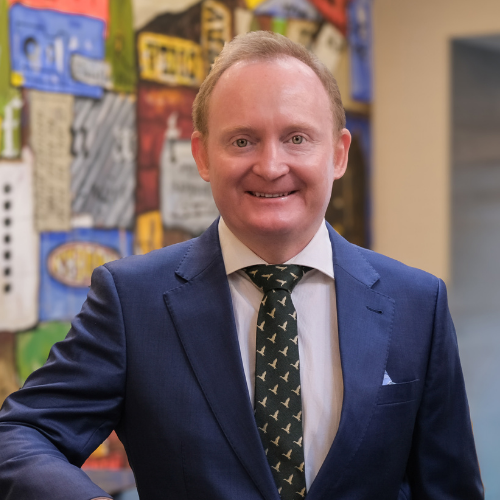
Nick Stewart
CEO
Stewart Group Asset Management

Q1: Looking back at past crises, what do you think individual investors most often misunderstand when markets first start falling?
Those who act rashly pay a heavy price – and often in ways they don’t fully see at the time. Even small, seemingly sensible changes to a portfolio carry real costs: transaction fees, potential tax consequences, and the time spent out of the market while waiting for conditions to feel safer.
That last one is particularly damaging. Markets tend to recover sharply and without warning, and missing even a handful of the best days in a recovery can significantly erode long-term returns. To put that in concrete terms: over the past 20 years, an investor who missed just the 10 best days in the S&P 500 would have seen their portfolio more than halved compared to someone who simply stayed invested. Those best days almost always come during or immediately after the worst periods of panic.
We saw this play out vividly in March 2020. Markets fell around 35% in a matter of weeks as COVID-19 took hold. Many investors sold, convinced things would get worse before they got better. They were right – briefly. But by August, markets had fully recovered, and those who had moved to cash faced a brutal decision: buy back in at higher prices, or stay on the sidelines and miss the recovery entirely.
There are also the hidden costs of fractured decision-making – acting on emotion or incomplete information, second-guessing the next move, and then having to decide when to get back in. The rash decision is rarely a one-off; it tends to set off a chain of further decisions, each compounding the original mistake.
Q2: Once a shock starts flowing into everyday costs and consumer behaviour, how does that change the way you think about risk and positioning in portfolios?
This is where evidence-based, engineered portfolio construction really earns its keep. We draw on the Fama-French factor framework – a body of academic research that identifies the persistent, systematic drivers of long-term investment returns beyond simple market exposure. The core factors we focus on are value (owning companies priced cheaply relative to fundamentals), profitability (companies with strong, durable earnings), and size (the historical premium associated with smaller companies).
When a shock works its way into real costs and consumer behaviour, these factors become particularly important. In an inflationary, higher-rate environment for example, highly valued growth companies – often priced for perfection – tend to struggle, while value-oriented and profitable businesses tend to hold up better. This is not a gut feeling; it is what decades of data consistently show.
Rather than reacting to headlines, we lean on the engineering of the portfolio itself – systematic diversification across factors, geographies, and asset classes – to absorb the stress. This approach keeps us from making emotionally driven tilts at exactly the wrong moment, while still allowing us to make considered, evidence-led adjustments where the data supports it. The discipline of the framework is the point: it takes the guesswork out of a moment when guesswork is most tempting.
Q3: When conditions still feel difficult, what principle should long-term investors keep front of mind to avoid making regret-driven decisions?
Ask yourself one question: has my financial plan changed? Not whether markets have fallen, not whether the news is frightening, not whether your neighbour has moved to cash – but whether the goals, time horizon, and personal circumstances that underpinned your plan are genuinely different today.
In most cases, for most investors, the honest answer is no. The plan was built to withstand exactly this kind of turbulence. Whether you are self-directed or working with an adviser, the discipline is the same – go back to the written plan, the original reasoning, and the long-term numbers, rather than the daily headlines.
Consider what happened to investors who held through the GFC. From peak to trough, the NZX50 fell 44% between 2007 and 2009. It was deeply uncomfortable. But those who stayed invested had fully recovered their losses within a few years and went on to participate in one of the longest bull markets in history. Those who sold locked in their losses permanently.
Regret-driven decisions almost always come from reacting to market conditions rather than personal circumstances. Volatility is not a sign that something has gone wrong with your plan – it is a feature of investing, not a bug. Stay anchored to what you set out to achieve, and let time and compounding do what they have always done for patient investors.
Disclaimer: The investment manager of ACI Funds is Stewart Group Asset Management (SGAM), and the issuer and manager of the funds is FundRock NZ Limited. The Product Disclosure Statement is available at www.acifunds.co.nz.
Disclaimer
The following commentaries represent only the opinions of the authors. Any views expressed are provided for information purposes only and should not be construed in any way as an offer, an endorsement or inducement to invest. All material presented is believed to be reliable but we cannot attest to its accuracy. Opinions expressed in these reports may change without prior notice.
This article is made available by InvestNow Savings and Investment Service Limited (“InvestNow”). The information and any opinions in this publication are based on sources that InvestNow believes are reliable and accurate. InvestNow, its directors, officers and employees make no representations or warranties of any kind as to the accuracy or completeness of the information contained in this publication and disclaim liability for any loss, damage, cost or expense that may arise from any reliance on the information or any opinions, conclusions or recommendations contained in it, whether that loss or damage is caused by any fault or negligence on the part of InvestNow, or otherwise, except for any statutory liability which cannot be excluded. All opinions and market commentary reflect InvestNow’s judgment on the date of this publication and are subject to change without notice. This disclaimer extends to any entity that may distribute this publication. The information in this publication is not intended to be financial advice for the purposes of the Financial Markets Conduct Act 2013, as amended by the Financial Services Legislation Amendment Act 2019. In particular, in preparing this document, InvestNow did not take into account the investment objectives, financial situation and particular needs of any particular person. Professional investment advice from an appropriately qualified adviser is recommended before making any investment decision. All investments involve risk.
Leave A Comment